
 By
By 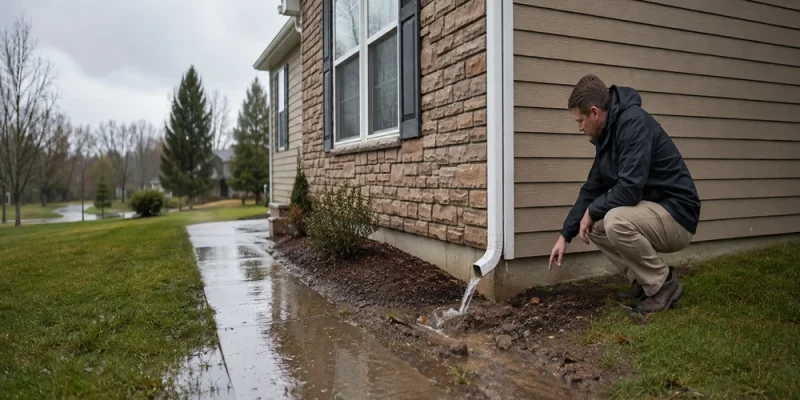
A puddle beside the foundation or a patch of washed-out landscaping may look like a problem at ground level. Often, however, the real cause begins several feet higher.
Rainwater follows a path from the roof to the gutters, through the downspouts, and eventually into the yard or drainage system. When one part of that route stops working correctly, the visible symptoms can appear somewhere else entirely.
Learning how to trace that path can help homeowners identify minor drainage problems before they become more difficult to manage.
Follow the Water Backward
When you notice an exterior water problem, start with the symptom but do not assume that is where the problem originated.
Suppose mulch repeatedly washes away beside the house. Replacing the mulch may improve the appearance temporarily, but it will not solve anything if water is being discharged into the same spot every time it rains.
Instead, work backward.
Look at where the water is collecting, then check the nearest downspout. Observe whether the downspout carries water away from the building or releases it beside the foundation. From there, look upward at the gutter serving that section of the roof.
The same approach works for soil erosion, persistent splashing against siding, water marks beneath the roof edge, and unusually wet areas around the property.
The goal is to identify the first place where rainwater stops following its intended route.
Start at the Roofline, Not the Puddle
The roofline is an important checkpoint because it is where a large amount of runoff becomes concentrated into a relatively narrow drainage system.
During safe conditions, homeowners can inspect the gutter line from the ground. Look for obvious sagging, separation from the fascia, crooked sections, or vegetation and debris extending above the gutter.
A rainy day can reveal other clues. From a protected location, observe whether water enters the gutter cleanly or spills over an edge. Notice whether one particular corner repeatedly overflows or whether water appears to travel behind the gutter.
Not every drainage problem is easy to diagnose visually. Gutters can be obstructed, incorrectly positioned, leaking, damaged, or connected to a downspout that cannot move water effectively. If the source cannot be identified safely from ground level, having a qualified gutter company inspect the roofline, gutters, downspouts, and related components can help determine which part of the drainage path actually needs attention.
That distinction matters because solving the source is usually more useful than repeatedly treating the symptom below it.
Check Where Downspouts Release Water
A gutter can collect rainwater correctly and still leave the property with drainage problems if the downspout releases that water in the wrong place.
Walk around the house and identify where each downspout ends. Look for depressions in the soil, disturbed mulch, exposed roots, or consistently damp areas near the discharge point.
Also consider the direction the ground slopes. Water that exits a downspout may simply travel back toward the building if the surrounding surface directs it that way.
Connections deserve attention as well. Sections that have become loose or disconnected can release water before it reaches the intended outlet. A blockage can create a similar problem by forcing water to back up or escape through joints.
The important question is not simply whether the downspout contains water. It is whether that water ends up somewhere appropriate once it leaves the system.
Pay Attention to Patterns, Not Just Individual Events
One unusual storm does not always indicate a permanent drainage failure. Repeated patterns are more informative.
Consider keeping a simple mental or written record of what happens during several periods of rain. Does the same corner overflow each time? Does one section of landscaping repeatedly erode? Does water consistently appear beneath the same section of gutter?
Patterns can help distinguish an isolated event from an ongoing maintenance or drainage problem.
They can also make troubleshooting more efficient. Instead of reporting that “the gutters are not working,” a homeowner can explain that a particular section overflows during rain or that one downspout continually releases water beside a problem area.
Specific observations make it easier to focus attention on the part of the system most likely to need investigation.
Look at the Entire Water-Management Path
Gutters do not operate independently from the rest of a home’s exterior.
The roof determines where runoff begins. Gutters collect it. Downspouts move it toward the ground. The surrounding landscape and drainage conditions then influence where that water goes next.
Problems can therefore occur at the transition between components.
A gutter might be clear while its downspout is obstructed. A downspout might work correctly but release water into a poorly drained area. Water may reach the roof edge but fail to enter the gutter as intended.
Thinking about the property as one connected water-management system helps prevent unnecessary repairs and repeated fixes.
Rather than asking only, “What is damaged?” it is often more useful to ask, “Where does the normal path of the water change?”
Conclusion
Exterior water problems are easier to understand when you follow the route rain is supposed to take.
Begin with the visible symptom, trace the water backward toward the roof, inspect accessible components from the ground, and observe what happens during rainfall when conditions allow you to do so safely.
Most importantly, look for recurring patterns. A single puddle may tell you very little, but repeated overflow, erosion, staining, or misplaced discharge can reveal where the drainage path is breaking down.
Treating the house as a connected system-from roofline to ground-makes it easier to address the cause rather than repeatedly dealing with the result.





Comments